Tours and guides – what to look out for
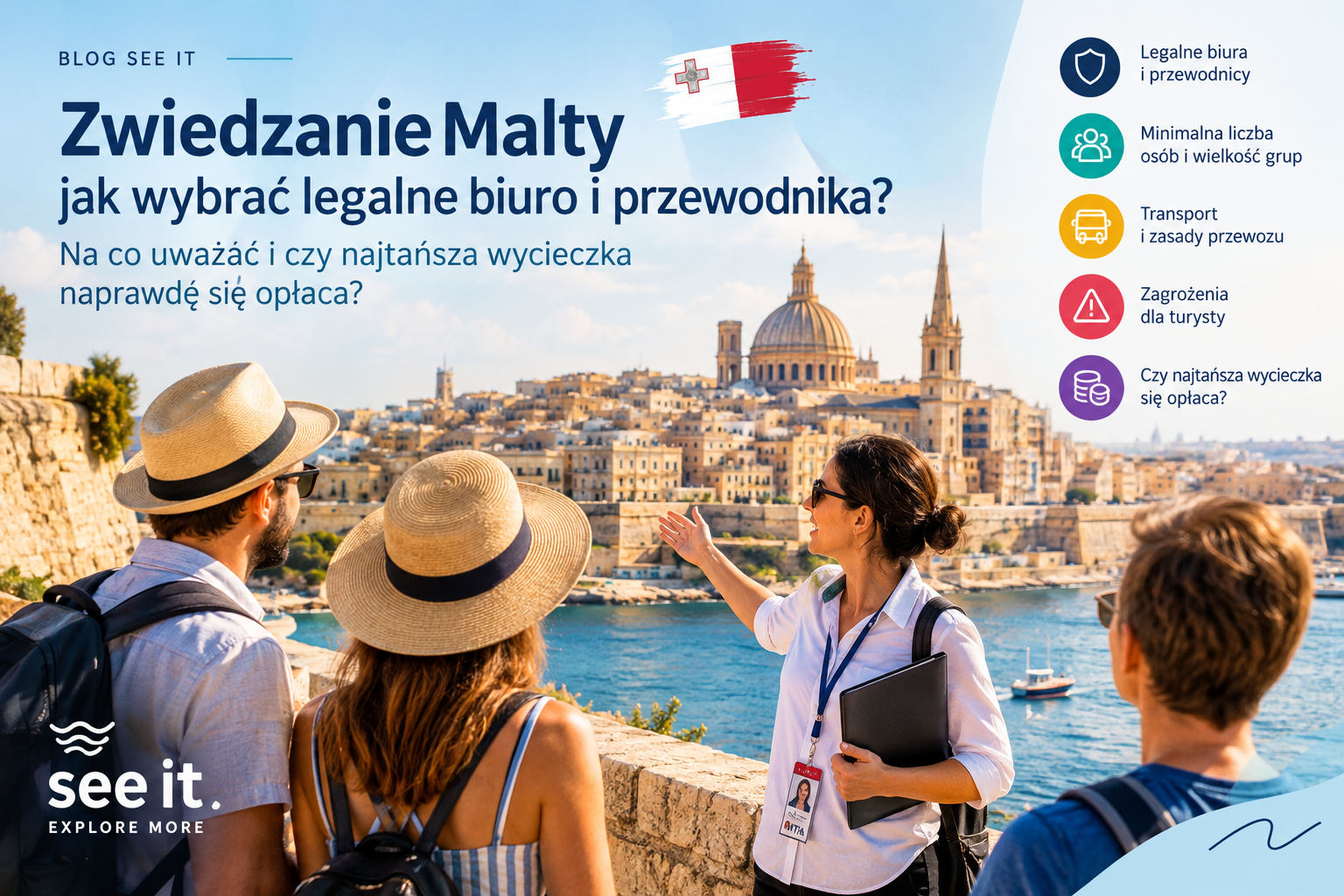
Malta is so much more than just beautiful beaches, turquoise waters and sunny weather. It is an island with a remarkable history, full of historic towns, megalithic temples, catacombs, fortifications and sites whose significance is difficult to grasp without the right context.
It’s no wonder that many tourists opt for organised tours of Malta, Gozo or Comino. You can find hundreds of offers online: from short walks around Valletta, through full-day sightseeing tours, to private guided tours and coastal cruises.
Prices, however, can vary significantly. Why does one tour cost a dozen or so euros, whilst another costs several dozen or even several hundred euros per person? Does every company offering tours operate legally? How can you recognise a licensed guide and check whether tourist transport is carried out in accordance with the regulations?
It’s worth asking yourself these questions before making a booking. A low price doesn’t necessarily mean poor service, but an attractive offer doesn’t exempt tourists from carrying out basic checks on the organiser.
In this article, See It explains what to look out for so that you can explore Malta with confidence, safely and without any unwanted surprises.
1. A legal travel agency and a licensed guide – they are not the same thing
One of the most important steps before booking a tour is to understand that the organiser and the guide may be two separate entities.
Who organises the tour? In Malta, certain types of tourist activities are subject to the regulations and licensing requirements of the Malta Tourism Authority (MTA). This applies, amongst other things, to tour operators and certain tourist services. If a company offers organised tours, it is worth checking whether it holds the necessary licences to carry out the specific activity. Official information on the licensing of tour operators can be found on the MTA website:
https://mta.com.mt/licenses-applications/travel-excursion-operator/
Who guides tourists? A tour guide performs a different role to that of a tour operator. They are responsible for guiding participants, providing information and interpreting the history and heritage of the places visited. In Malta, tour guiding services are subject to separate regulations. Anyone carrying out activities subject to a licensing requirement must hold the appropriate licence. Official information on tour guide licences:
https://mta.com.mt/licenses-applications/tourist-guide/
Why is this important? A company may hold the necessary authorisation to organise tours, but this does not automatically mean that every person leading its groups holds the required tour guide licence. Similarly, a licensed tour guide does not necessarily have to be the owner of a travel agency. It is therefore worth checking both the organisation selling the service and the person who is to guide the participants.
2. How can you check whether the organiser is operating legally?
You don’t need to know Maltese law to carry out a basic check. All it takes is a few simple steps.nCheck the company in the official register
The Malta Tourism Authority provides information on licensed tourism operators. Start with the official website:
https://mta.com.mt/licensed-establishments/
Search for the company, paying attention to its legal name and business category.
If you cannot find the operator, do not immediately assume that it is operating illegally. The company may use a different trading name, and requirements may vary depending on the type of service provided. Ask for the licence number and, if in doubt, contact the MTA.
Check the seller’s details. Before paying, make sure you know who you are entering into a contract with. Simply having a presence on Facebook, Instagram or TikTok does not confirm that the business is legitimate. On the other hand, a small business without an elaborate website is not necessarily dishonest.
You should be particularly wary of a lack of details about the service provider, conflicting information, a refusal to explain the terms and conditions, and pressure to pay immediately.
Are online reviews enough? Reviews from other travellers can be helpful, but they are no substitute for checking the organiser’s credentials. A company may have excellent reviews yet still fail to meet all the requirements for a particular service. Conversely, a small number of reviews does not automatically mean that the organiser is operating illegally. It is best to treat reviews as one element of your assessment, alongside documents, the transparency of the offer and the manner of communication.
3. How can you recognise a licensed tour guide in Malta?
A licensed tour guide should carry an identification document issued by the relevant authority. In accordance with Maltese regulations governing tour guides, the ID badge must include, amongst other things: a photograph of the guide, their full name, registration number, period of validity, and the language in which the guide is authorised to conduct tours.
Whilst conducting a tour, the guide is required to wear the ID in a visible place. A name badge, a T-shirt with a company logo, a business card or a staff ID card are not the same as a guide’s licence.
4. Transport for tourists – an important warning regarding hire cars
This is one aspect to which you should pay particular attention when booking sightseeing tours.
Not every tour operator is also a licensed transport provider. The mere fact of holding a tourist licence does not automatically confer the right to provide every form of paid passenger transport.
Is it possible to hire a standard car and use it to carry tourists for a fee? You should not assume that a standard car hired from a car hire company can automatically be used for the commercial carriage of passengers.
In Malta, passenger transport services are subject to separate regulations set out by Transport Malta. The requirements depend, amongst other things, on the type of vehicle, the nature of the service and the category of business.
In practice, a distinction must be made between:
Standard car hire – the vehicle is used in accordance with the terms of the hire agreement.
Paid transport of tourists – the company transports customers as part of a paid service, which may require appropriate licences, permits and compliance with additional conditions.
Transport commissioned to an authorised carrier – the organiser may collaborate with an entity that holds the necessary authorisations to provide the transport service.
If the organiser offers transport as part of a tour, they should ensure that the manner in which the transport is carried out complies with applicable regulations and the terms and conditions of vehicle use.
The most important rule: hiring a car does not replace the required authorisations for the commercial carriage of passengers.
This does not mean that every car trip is illegal, nor that every vehicle from a hire company is excluded from all tourist activities. Legality is determined by specific conditions, the type of service, the status of the vehicle and the relevant authorisations.
Therefore, one should not simply assess whether a car is hired. What matters is whether it is being used in accordance with the regulations and the contract.
Official information on passenger transport can be found on the Transport Malta website:
Why is this important for tourists?
Proper organisation of transport is important for passenger safety, accountability for the service and the ability to resolve issues in the event of an unforeseen situation.
Before booking, it is worth asking who is actually responsible for the transport, what type of vehicle will be used, and whether the service is provided by the organiser or a partner transport operator.
5. Is the cheapest tour really worth it?
Price matters. Especially when you are travelling with your family and planning several attractions during a single stay.
However, there is no reason to automatically rule out the cheapest offers. A cheap trip can be a very good option if it has a clear itinerary, is well organised and meets your expectations.
It is worth checking, however, what accounts for the difference in price.
Let’s imagine three examples of how to explore Valletta.
Budget option: a larger group, a fixed timetable and a basic itinerary. This could be a good choice for those who want to see the main sights at an affordable price.
Standard tour: a smaller group, more time for questions and a more in-depth tour. This option may appeal to those interested in history and local culture.
Private tour: your own pace, greater flexibility and the option to tailor the itinerary. It usually costs more, but can offer a level of comfort that a group tour does not.
These are examples only and do not guarantee the standard of every offer. Compare the scope of the service, not just the price. Let’s say one tour costs 20 euros and the other 35 euros per person. The difference is 15 euros. If the more expensive option includes a 10-euro admission ticket and also offers a smaller group and a longer tour, its higher price may be justified.
However, if both offers include the same itinerary, duration, tickets and standard of service, a higher price does not necessarily mean better quality. Don’t pay more just because an offer is more expensive. Nor should you choose the cheapest option simply because it has the lowest price.
Look for the best combination of quality, transparency and cost.
6. Is it worth exploring Malta on your own?
Absolutely. There are plenty of places you can explore at your own pace.
Valletta, Mdina, the seaside promenades and numerous viewpoints are ideal for exploring on your own. You can use public transport, plan your own routes and choose attractions based on your interests.
Exploring on your own saves money and gives you a great deal of freedom. However, it also has its limitations: information on the internet can sometimes be incomplete, and the historical significance of certain monuments is not always obvious.
A good guide can bring a place’s history to life, point out details that are easy to miss, and explain the local cultural context.
You don’t have to choose exclusively between a full-day tour and independent sightseeing. You can combine both approaches: explore parts of Malta at your own pace, and hire a licensed guide for the most important sights.
Summary – explore Malta with confidence with See It
Malta offers extraordinary sightseeing opportunities. You can explore it on your own, join a group tour or hire a private guide. Any of these options can be a good choice, provided it suits your needs and is properly organised.
Before booking, bear in mind these three rules:
-
Check credentials. Verify the organiser, the guide’s licence and transport requirements, depending on the type of service.
-
Compare the actual value. Take into account the duration, itinerary, tickets, transport, group size and the guide’s expertise.
-
Don’t ignore warning signs. A lack of seller details, unclear terms and conditions, hidden fees and pressure to pay immediately should prompt you to exercise caution.
The best trip doesn’t have to be the most expensive. However, it should deliver on its promises, be well organised and allow you to explore Malta without any unnecessary stress.
Discover Malta at your own pace with See It. Plan your own itineraries, learn about the island’s history and choose the way of exploring that best suits your expectations.
Official sources and useful links
Malta Tourism Authority – tour operators: https://mta.com.mt/licenses-applications/travel-excursion-operator/
Malta Tourism Authority – tourist guides: https://mta.com.mt/licenses-applications/tourist-guide/
Malta Tourism Authority – register of licensed operators: https://mta.com.mt/licensed-establishments/
Transport Malta – information on transport and passenger carriage: https://www.transport.gov.mt/
Note: This article is for educational purposes only and does not constitute legal advice. Requirements regarding licences, passenger transport and the organisation of excursions depend on the type of business and the regulations currently in force. If in doubt, please confirm the specific requirements directly with the Malta Tourism Authority or Transport Malta.
Share:
Explore Malta and Gozo with the See It app